
Citizen Sane: Kindness
Values that a Citizen of India in 2026 should aspire for.

A citizen must be kind.
Kindness cannot be taught, but people can be influenced to be unkind to each other. That’s what our current political system does. It rakes up issues of identity, caste, language, region, culture, religion, gender and more, just so that people divide themselves into different groups & teams. Then they pit one team against the other, just so they can gain votes as a block.
Citizens have been stripped of their humanity reduced down to statistics & voter blocks, which in itself is an unkind act enabled by political parties whose singular goal is to win elections. In this process, the main ingredient used by political parties is HATE.
And hate is another word for: “Be unkind to the people who are not like you”.
In the political system of India, kindness is mostly absent. All the people who would describe themselves as “kind” have been systematically kept away from this toxic whirlpool of hate. They are the pariahs of politics in 2026. Being “kind” is considered a weakness in an arena where you are taught to be ruthless, hateful, abrasive and unkind.
Is it a weakness? Or are there certain advantages to being a generally kind citizen?
SIDENOTE: The moment I ask the question “what are the advantages of being kind?”, I am fully aware that the act of kindness can morph into selfishness… but we’ll come to that later.
So, what is Kindness?
When a citizen does acts that are:
Selfless
Generous
Friendly
Without expecting anything in return
That’s kindness.
First, a selfless act would entail totally ignoring your ‘self’ (your ego) before doing the said act. A citizen who is hyper-focused and locked in to the needs of others around them, and do acts which improve the well being of such people, would be doing a selfless act. Selflessness comes instinctively, it might not be a conscious choice. I would argue it should not be a choice at all, it should be a default setting.
Second, a generous act would entail giving up a part of your own comfort to benefit others. The human endeavor in 2026 is to improve, increase and even maximize personal comfort. That can be done through gathering wealth, fame and power. But a generous act would entail giving up either of those to someone else who needs it more. It can be charity, platforming worthy people or transferring power to those below you on the socio-economic ladder.
Third, a friendly act would entail everyday meaningful interactions with fellow citizens. A simple act of smiling meaningfully, engaging in banter, joking about, or offering a shoulder to cry on, can go a long way towards being a kind citizen. Here, the act of LISTENING is an important trait that needs to be honed within a citizen so that these acts of friendliness just happen unconsciously.
Fourth, most important, one must do all these acts without expecting anything in return. In 2026, you see that every act done around you is with the intention of getting something in return for yourself. This ties in to the earlier point about pro-maxxing personal comfort. There needs to be an awareness in every citizen that wealth, fame and power are limited in quantity. When you gather either of those, there is someone else who is losing out.
Selflessness is about gaining awareness about this simple fact and doing acts to rectify it. But these acts should be done unconsciously, that is the only way one can do it without expecting anything in return. The moment you think about the ‘selfless act’ you are engaging in, you start to see advantages and disadvantages of doing so. That is when you start weighing how it benefits or disadvantages you.
Having said that, it is worth noting that acts of kindness do have some advantages in the larger socio-political project called India.
These are the few I have identified (for now):
Breaking Barriers: Kindness allows a citizen to expand their horizons by interacting with and forming connections with other citizens who are NOT like them. It helps them touch grass.
Enable Conversations: Kindness enables communication and exchange of ideas. Once barriers are broken, conversations begin and citizens start learning from each others experiences. Collectively, we become stronger and more resilient.
Build Trust: In a low trust society like India in 2026, Kindness can be the antidote to building it up again.
Reduce Stress: At a personal level, kindness enables citizens to find community and get rid of their isolation. It reduces stress and provides a feeling of safety + security since they are actively removing their personal fears about other people by putting themselves out there.
Kindness can be a tricky virtue to execute in the real world. The best way to describe it is Crowd Surfing.
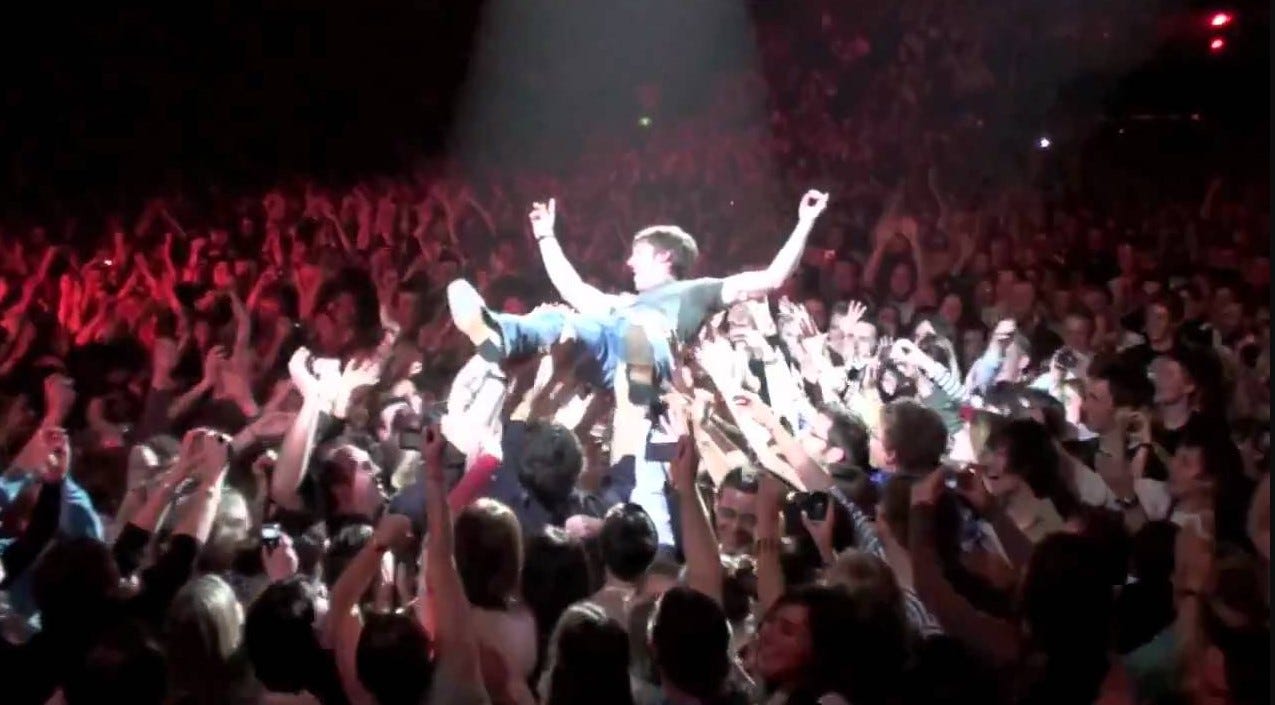
When a rockstar performing on a stage jumps into the audience, desperately hoping that the crowd will catch them and put them back on the stage, that is what kindness looks like.
The rockstar is hoping that their crowd is full of kind people who won’t let them fall down. But it’s a hope, not a guarantee. When they jump, the rockstar is not expecting the crowd to cushion their fall. They are hoping it would happen. On the part of the crowd, their act of extending the hand up to grab their favorite rockstar is almost an instinctive and protective act. It’s them being kind without even realizing what is happening. There might be an innate desire to protect the person who is jumping onto them, but it doesn’t have to be a conscious choice they make.
The crowd is being kind to the rockstar who is crowd-surfing.
How does one enable citizens to be kind? Is it even possible to inculcate kindness within people or is it a quality that you either have or just don’t.
Perhaps one way to look at this problem is to assume that all humans are kind to begin with, but it is beaten out of them as they grow up. Sometimes quite literally. But this is also a privileged notion to have. If you are born in abject poverty, in a slum and have literally nothing, when everyday existence is a struggle and you don’t know where your next meal is coming from, expecting acts of kindness from this person would be cruel.
In India, 100 crore plus people, or 60% of our population is in this situation. Desperation leads to people being unkind to each other, hunger leads to murder and violence, homelessness leads to an innate base desire to snatch shit from others. Joblessness leads to violent uprisings, young men dancing on mosques and a general disdain towards society which enabled this hopeless situation.
Is it even possible to expect kindness in such a situation? How does one build up compassion and empathy in a citizenry that is desperate, poor, angry, frustrated and numb?
It’s a question worth asking and thinking about. I don’t have the answer right now, but maybe I will one day.
Perhaps, every citizen can do acts of kindness which are in the realm of possibility first. They can start by being kind to themselves first, then move on to the rest of the world.
This is important because 2026 India forces you to be unkind to yourself as well. Every citizen is growing up in a world that is hell-bent on making them feel triggered and insecure about themselves 24x7. It forces citizens to constantly monitor their behavior, body, bank accounts, properties, relationships and their work. Citizens are required to maximize their ‘worth’ in the market. To sell themselves and their skills by hook or crook. It forces you to constantly think in terms of doing selfish acts that benefit yourself, not kind acts that benefit others. Because our current social zeitgeist has decided that kindness is for stupid people.
Unfortunately, the people who have the capacity to do kind acts are more inclined to conduct violence on the have-nots through unkind acts. This is not a blanket statement, of course. There are citizens out there who have the capacity for kindness but don’t know how. Or they are in a situation of stasis, a paralyzed state induced by those who see kindness as a weakness, as stupidity.
Maybe it’s time to find the second category of people shake them out of their stasis traps, to remind them that “hello my lovely Citizen Sane. Here’s a reminder that you are kind, you are smart, and you are important. And you are NOT fucking alone.”
A citizen can and must be kind.
While I agree with and support the call to selflessness, I must submit that it is a conscious choice made by rational individuals. Asking for it to be instinctive and unconscious is wishful. The person who does the kind act must know the consequences and still make it happen, despite the cost to them. That is how it would become a virtue. I also agree with you that the societal pressures of today and the normative behaviour does not encourage selflessness. However, I cannot accept the correlation you imply between poverty and unkindness. It is a popular theme and seems intuitively plausible but it is a generalisation which is not true. Any number of anecdotal evidence would not be enough to support the theory. Material resources are only incidental and not essential for a kindness to be performed. Thank you for the timely piece pointing out the crying need for compassion and generosity today.
A bit of friendly criticism: "Pariah" Is a casteist slur, named after the Paraiyar community of Tamil dalits. It's highly offensive to use it in this context.